THRONE 30

COMPUTATIONAL BIM DELIVERY WORKFLOW

CROSS-SCALE ARCHITECTURE

PLATFORM FOR AUTOMATION

PLATFORM FOR AUTOMATION

GENERATIVE SPATIAL STRATEGIES

GENERATIVE SPATIAL STRATEGIES

Institution

Columbia Universtiy GSAPP

Location

New York, NY

Date

2025

Role

Adapted and extended studio starter scripts for zoning, structure, and facade. Expanded the structural system beyond the base column-beam setup and upgraded the facade family to 5-point adaptive family. Authored original view + wind analysis scripts and diagrams. Post-viewer, reconstructed all portfolio drawings and renderings and substantially rebuilt the Revit model (full-core revision, resolved program and circulation).

Original Exhibition Team

Original Exhibition Credits

Post-Exhibition Development

Acknowledgments

Mixed-Use Tower in NoMad

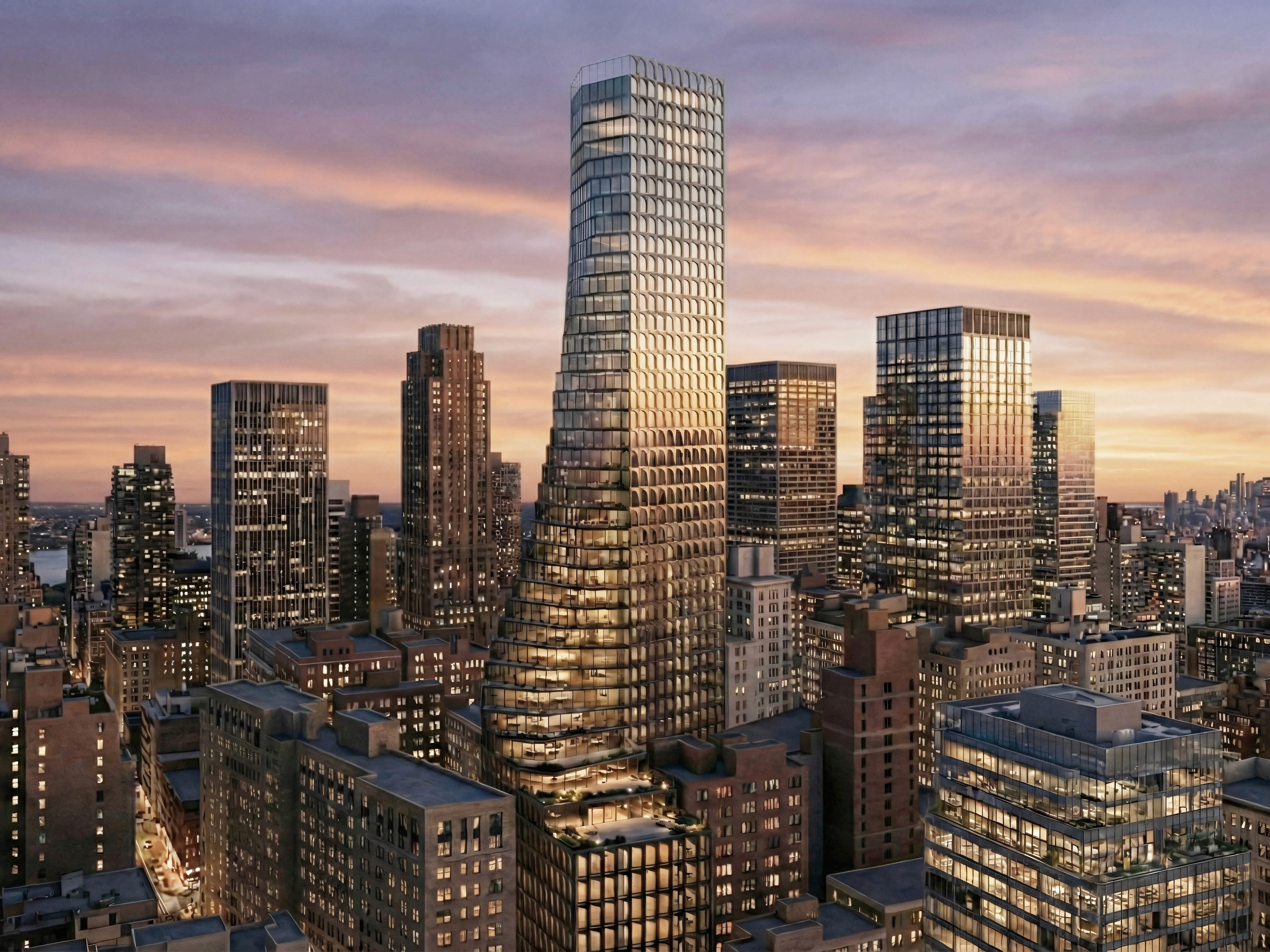
Developed within Rethinking BIM at Columbia GSAPP under the instruction of Joe Brennan, AIA, Throne 30 is a simulation-driven mixed-use tower at 1227 Broadway in Manhattan's NoMad district. Rather than treating environmental analysis as a post-rationalization step, the project positions view simulation, CFD wind analysis, and zoning verification as the primary generative drivers of architectural form. Six candidate massings were evaluated through custom Grasshopper scripts before a rotated parallelogram geometry was selected for its optimal balance of view access, wind performance, and regulatory compliance under the M1-8A/R12 envelope. The tower's computational workflow extends from massing through structure, facade, and floor plates, all parametrically generated in Grasshopper and pushed to Revit via Rhino.Inside.Revit, establishing a continuous pipeline where design exploration and BIM documentation operate as a single integrated process. Throne 30 demonstrates that computation can serve not only as a tool for formal invention but as the connective medium between urban constraint, architectural ambition, and deliverable reality.
Custom Analytical Tools for Massing Optimization

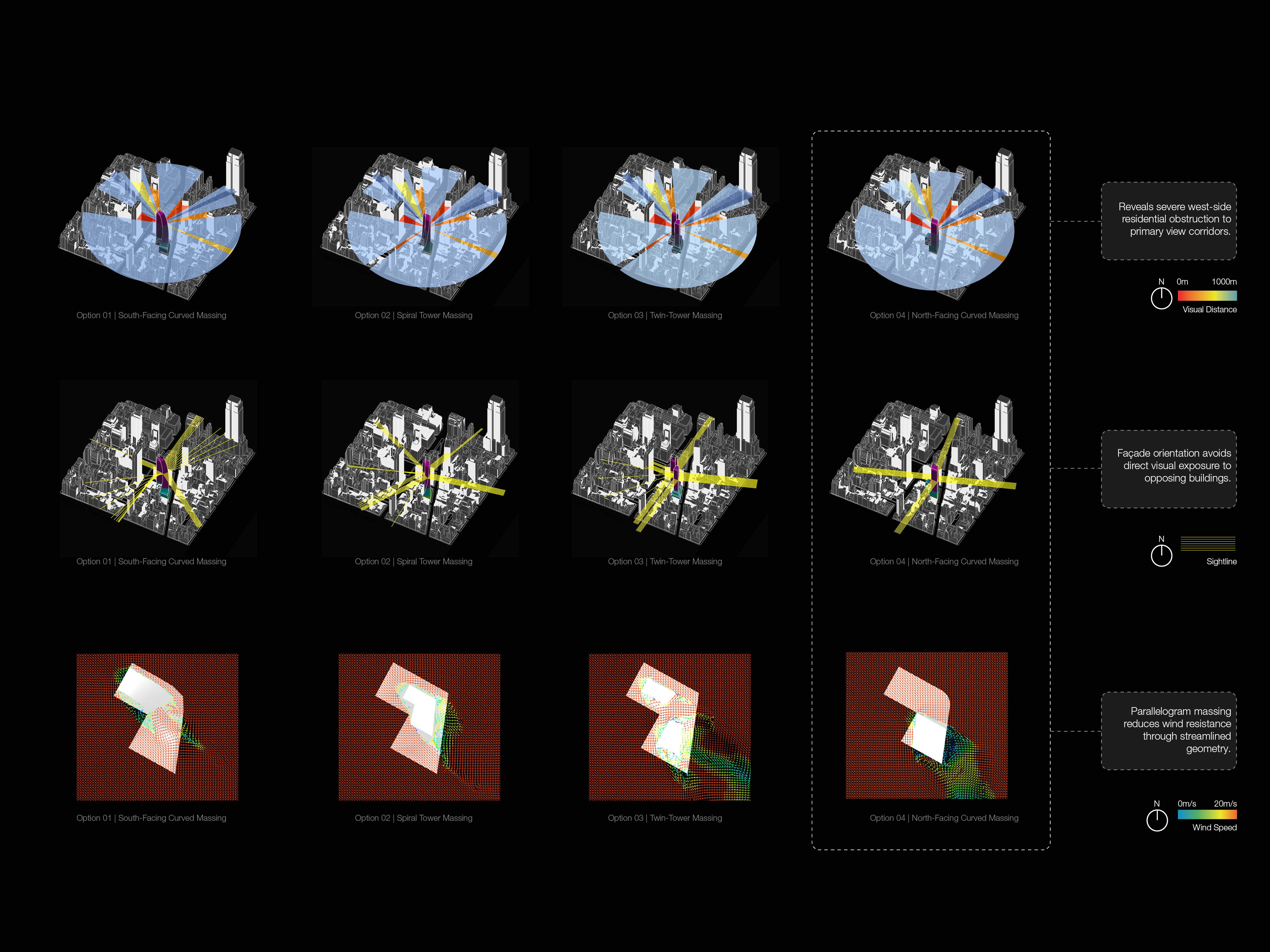
Three original Grasshopper scripts were developed to evaluate massing options before any design commitment, converting environmental performance data into direct form-finding criteria. Each tool tests six candidate massings against the same site context, producing comparable results that guided the final selection of the north-facing curved parallelogram.

Panoramic View Analysis

The panoramic view script casts radial sightlines from every facade point and maps visual distance to a color gradient spanning zero to one thousand meters. Applied to all six massings, it revealed severe west-side obstruction cutting into primary view corridors, establishing a baseline readability of view access at the earliest massing stage.
Directed View Vector Analysis

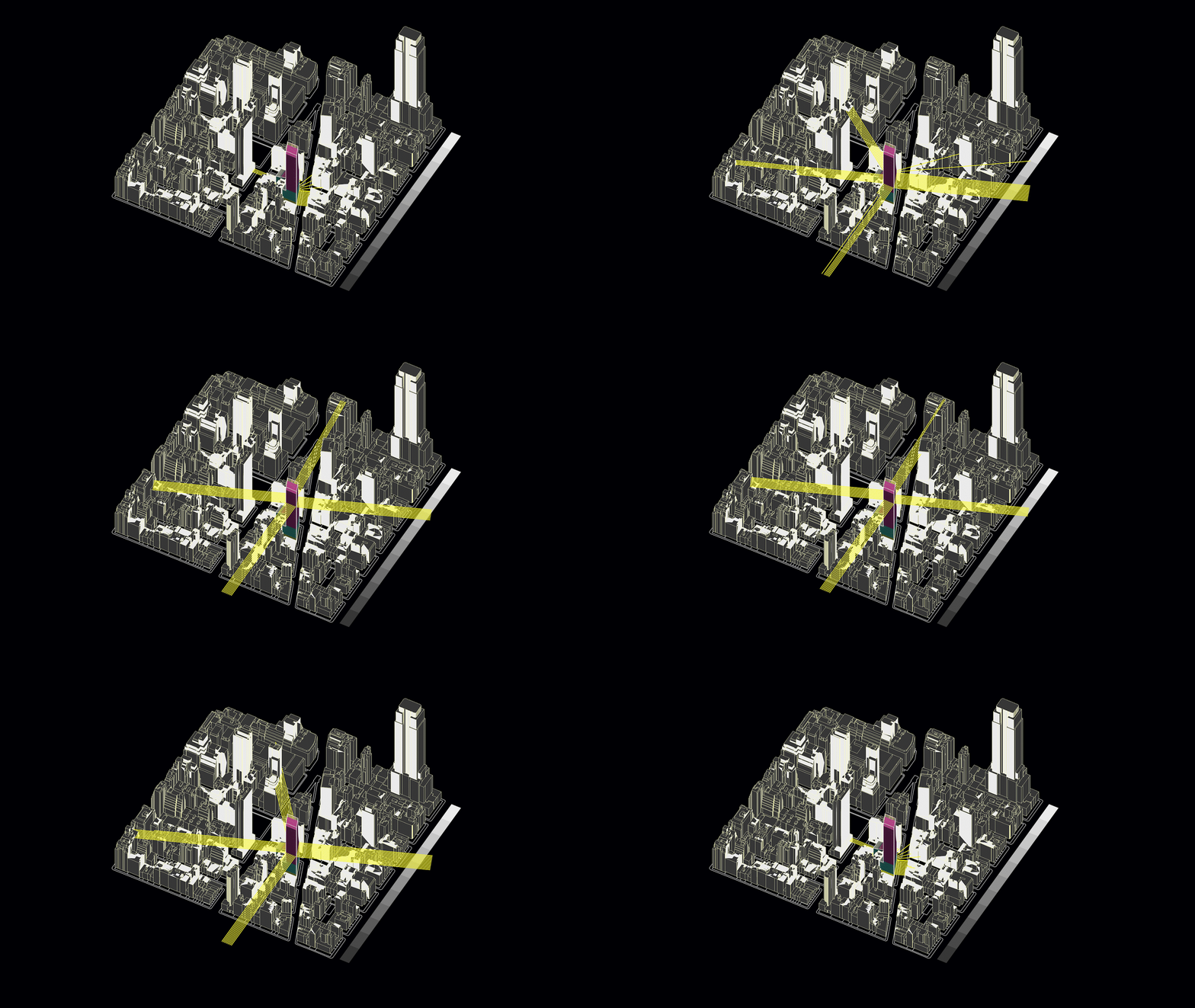
The directed view script fires perpendicular sightlines from each facade surface, testing whether they terminate at an opposing building. The analysis revealed a west-side building directly blocking primary sightlines, so the final parallelogram massing tilts one facade plane to deflect away from that obstruction, reinforcing the rotated geometry as the most view-effective strategy.
Institution

Columbia Universtiy GSAPP

Location

New York, NY

Date

2025

Team

Mia Miao, Tommy Wang, Yunhao Zhong, Judy Zhu

Role

Adapted and extended studio starter scripts for zoning, structure, and facade. Expanded the structural system beyond the base column-beam setup and upgraded the facade family to 5-point adaptive family. Authored original view + wind analysis scripts and diagrams. Post-viewer, reconstructed all portfolio drawings and renderings and substantially rebuilt the Revit model (full-core revision, resolved program and circulation).

Critic

Joe Brennan, AIA

Recognition

Awarded High Pass

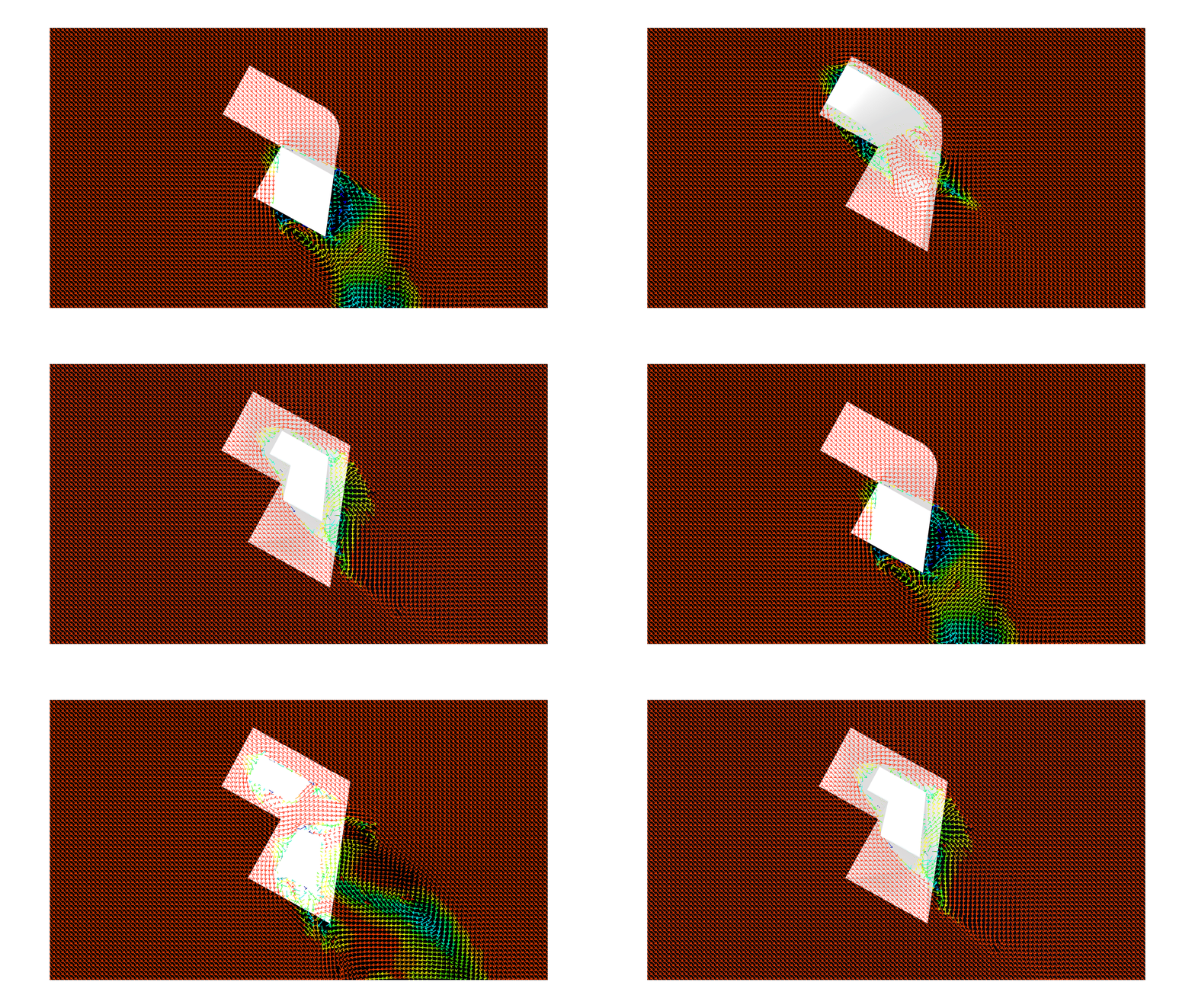
CFD Wind Analysis via Eddy3D

Wind simulations processed through Eddy3D and OpenFOAM quantified pedestrian-level and upper-floor wind speeds under New York's prevailing northwest wind. Among all candidate massings, the parallelogram geometry minimized overall wind pressure on the building, its streamlined profile reducing drag and deflecting prevailing gusts most effectively. This result was a key factor in selecting the parallelogram as the final massing strategy.

Zoning Envelope Compliance

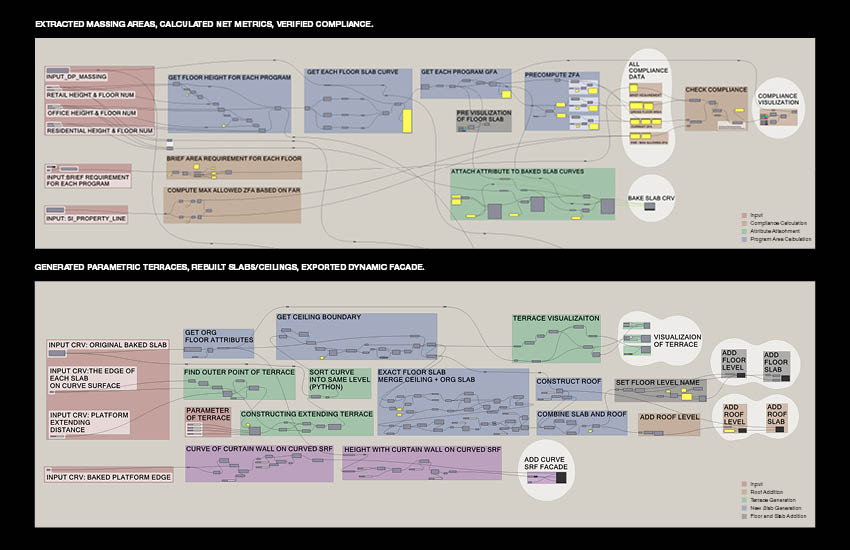
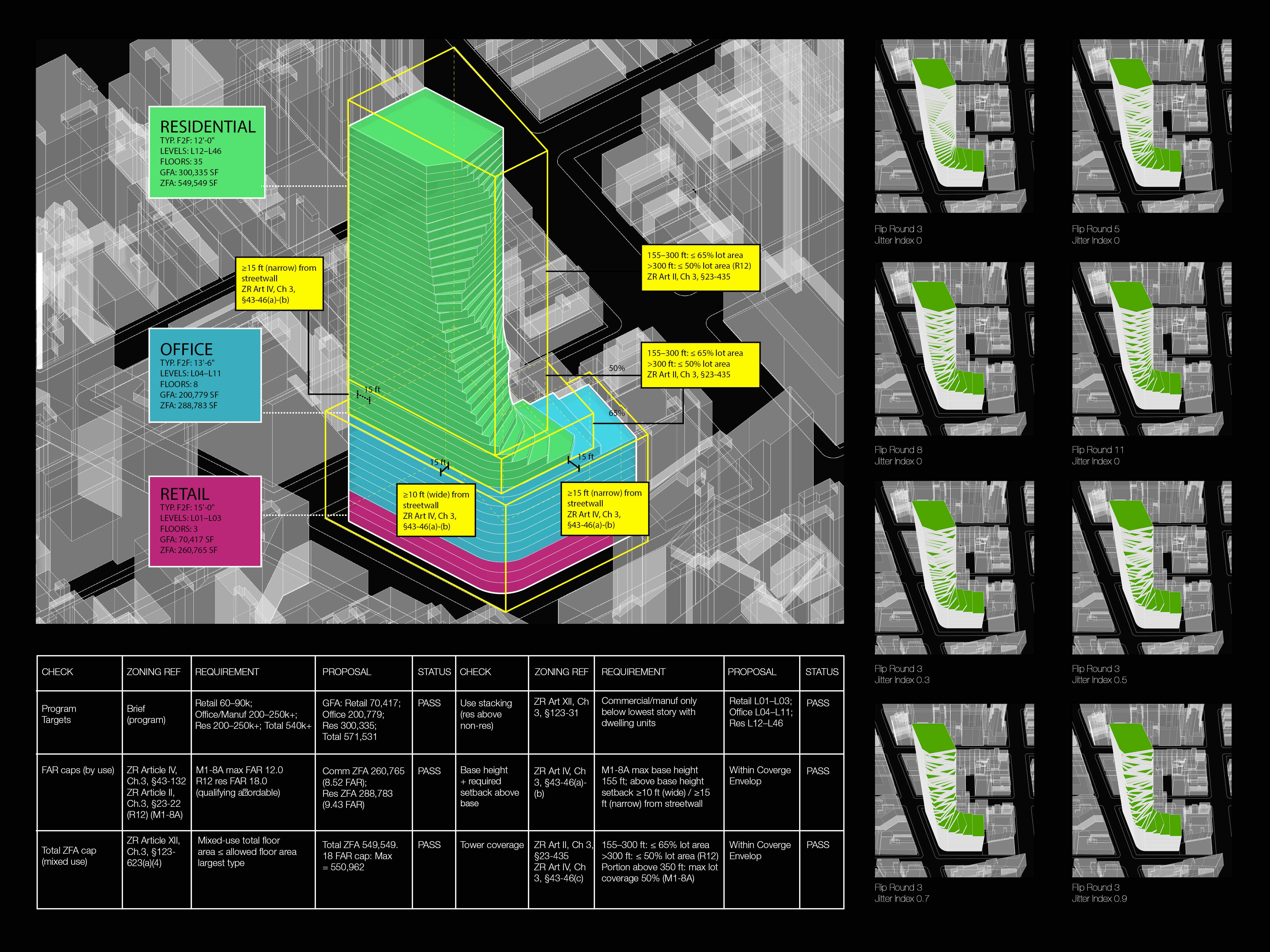
The design must sit entirely within the M1-8A/R12 zoning envelope, satisfying FAR caps, use-stacking rules, base-height setback requirements, and tower coverage limits simultaneously. A code-driven approach embeds these regulatory constraints directly into the parametric model so that every massing iteration is checked against zoning in real time rather than verified after the fact.

Generative Terrace Design

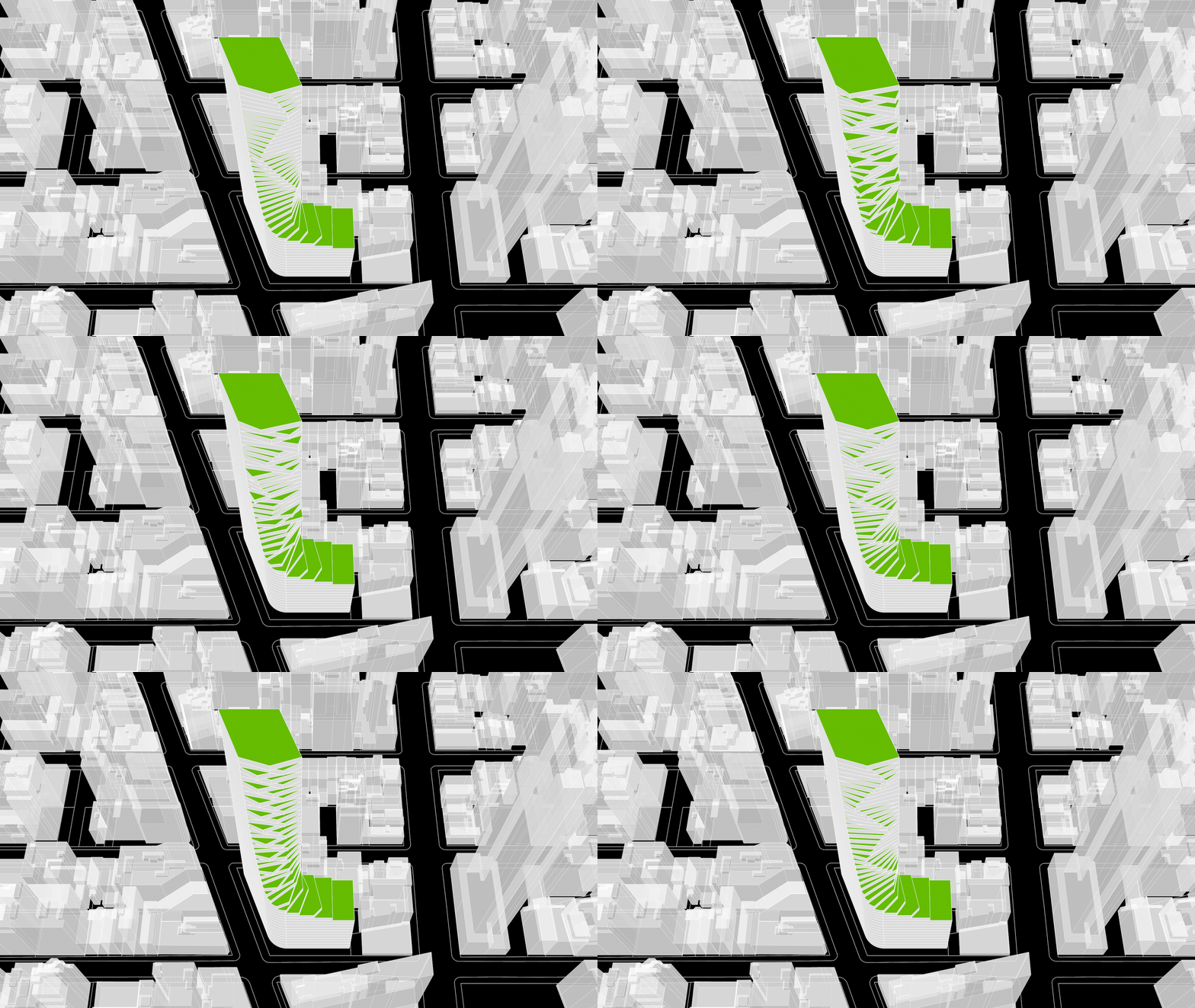
Terraces are algorithmically generated through a parametric routine that flips slab edges outward in controlled rounds. A jitter index from zero to 0.9 randomizes extension depth per floor, producing naturalistic variation across the north-facing curve. The script merges terrace slabs with original floor plates and exports combined geometry as Revit-ready levels.

Project Catagory

Institution

Columbia Universtiy GSAPP

Date

Location

New York, NY

Housing as Theater

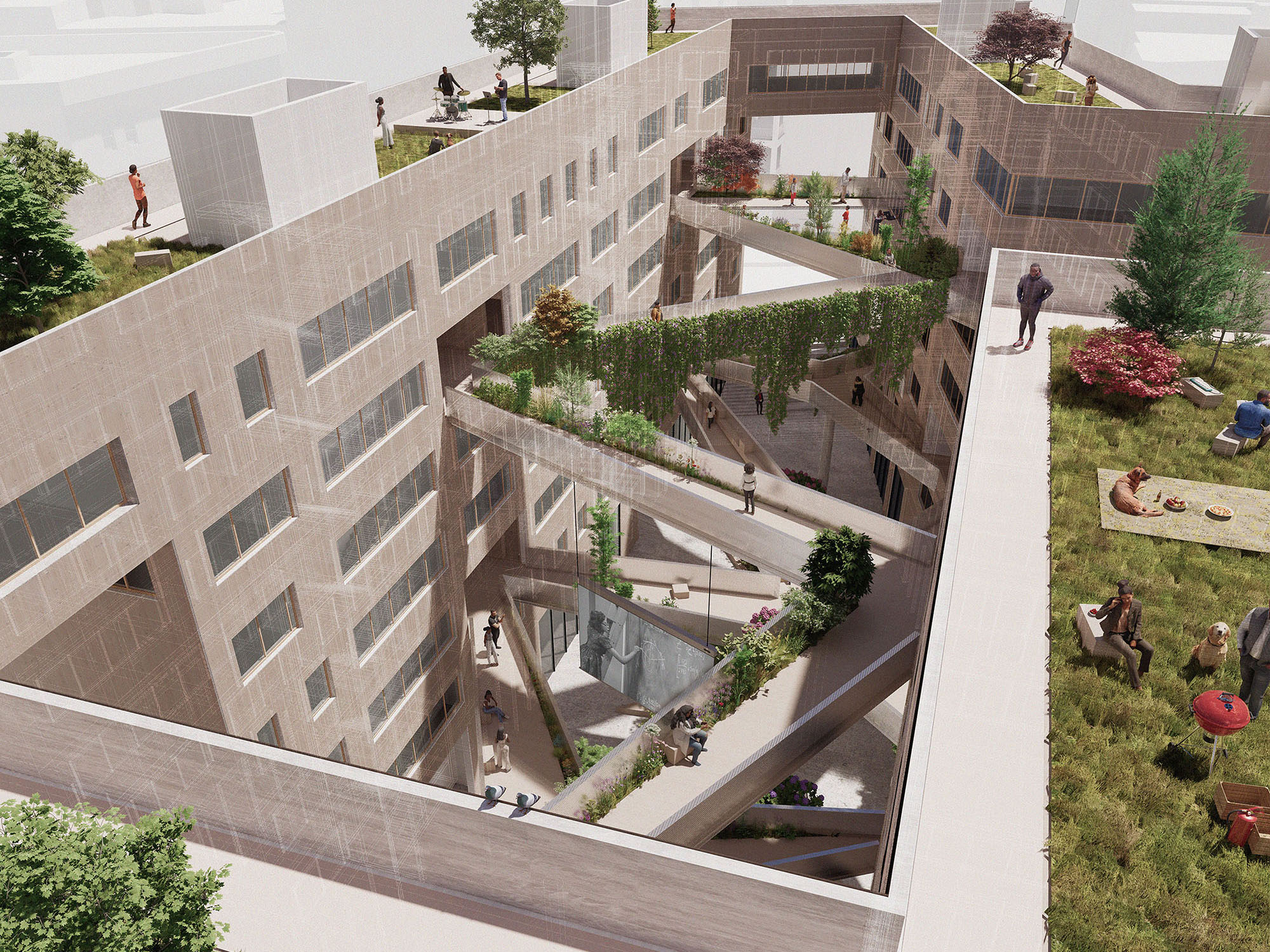
As residents traverse these connectors, they witness fragments of life unfolding across different levels—gardening, conversation, play, and performance. These interwoven visual and spatial experiences construct a “vertical theater”, where everyday life becomes visible, shared, and staged. In this reimagined framework, housing is no longer a static shelter but a performative scaffold for resilience, collectivity, and belonging.

Floor Plans and Office Spatial Strategy

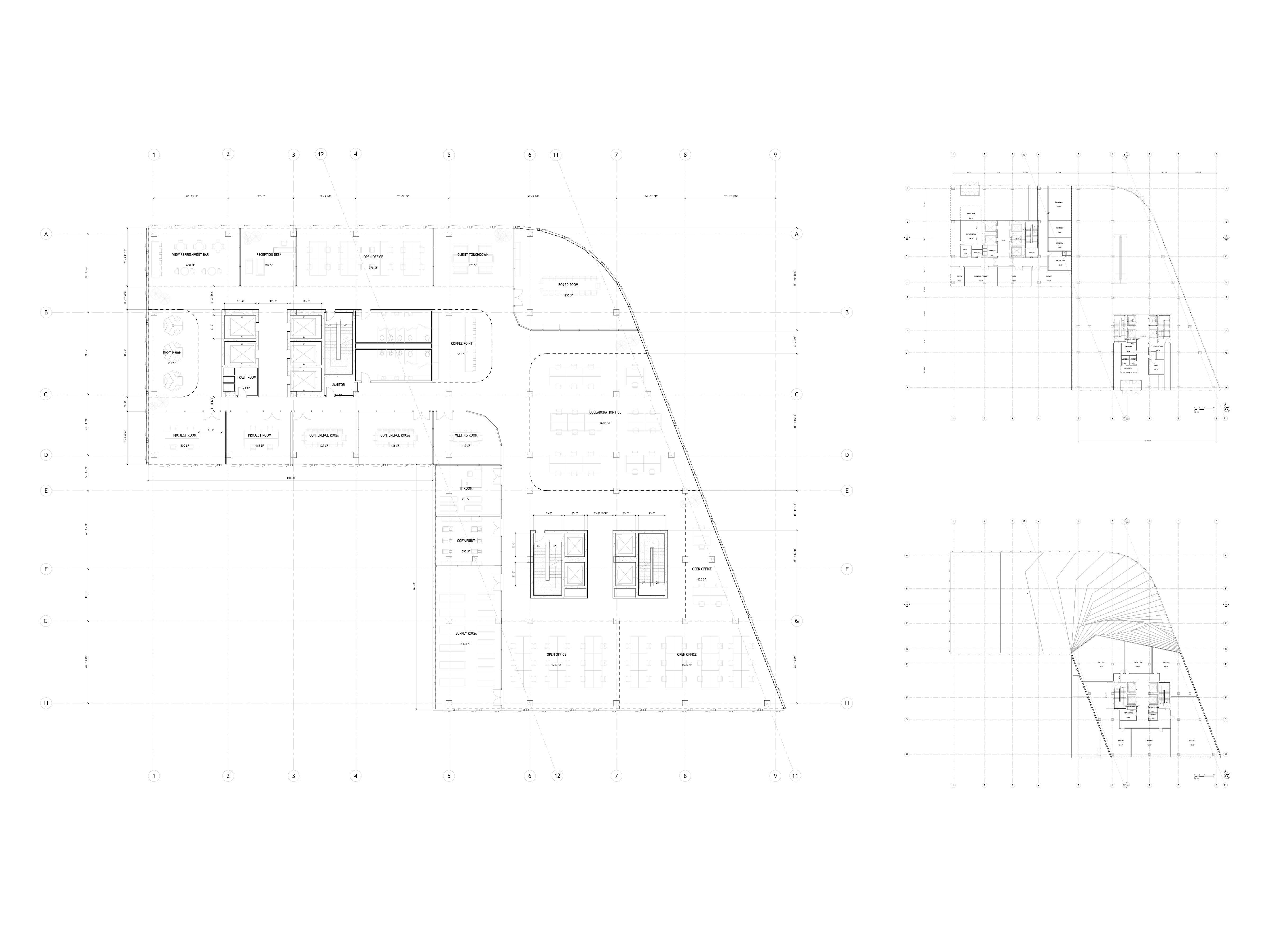
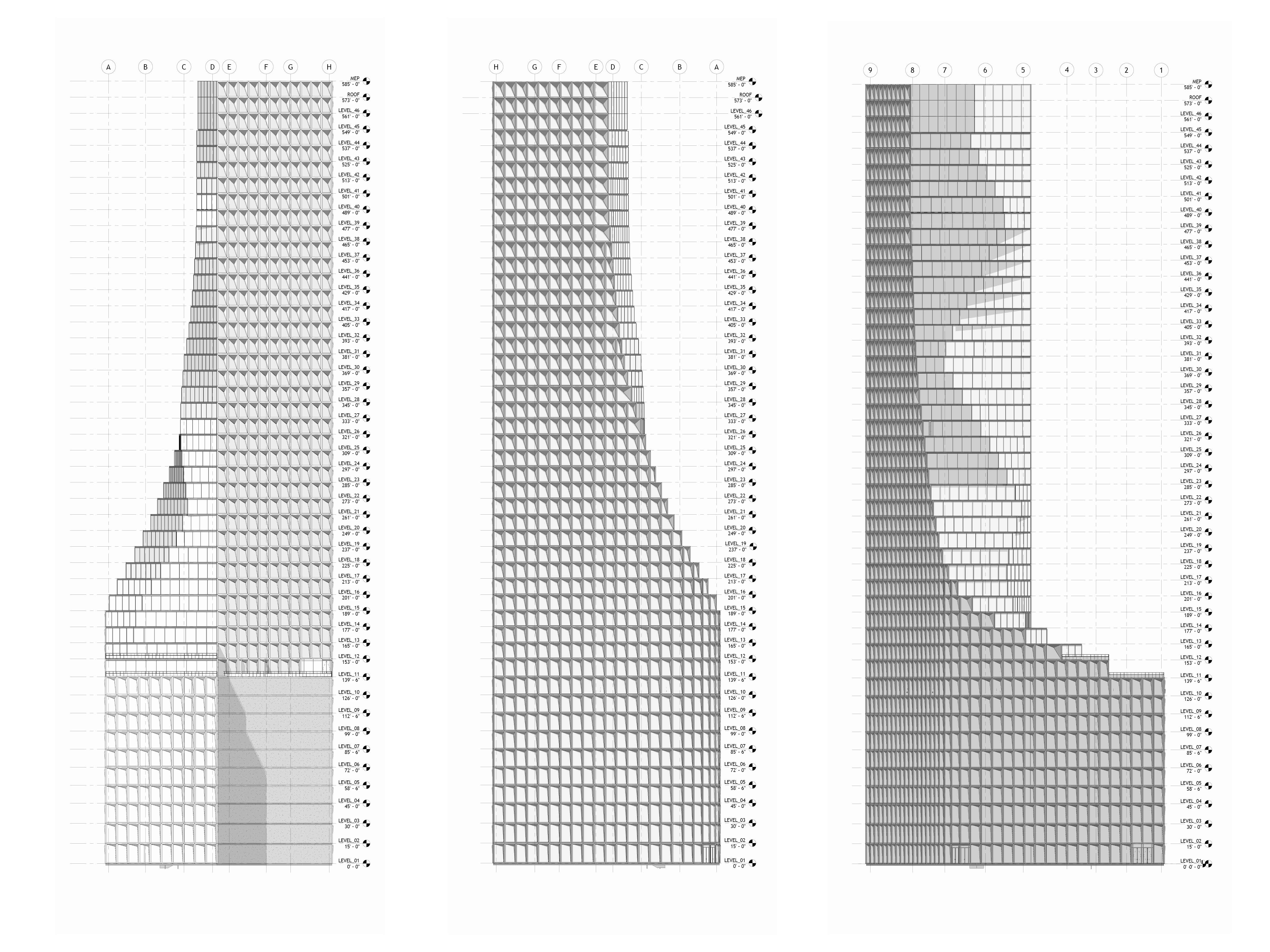
The irregular footprint required careful planning across three programmatic zones. The retail podium opens onto Broadway, drawing street life into the base. Office floors deliver a daylight-rich workplace organized around open neighborhoods, quiet edges, and shared skyline lounges, functioning as single-tenant headquarters today while convertible to multi-tenant leasing. Residential levels above feature fan-shaped unit plans generated by the curving north facade that maximize Empire State views.

Automated Structural Generation via Rhino.Inside.Revit

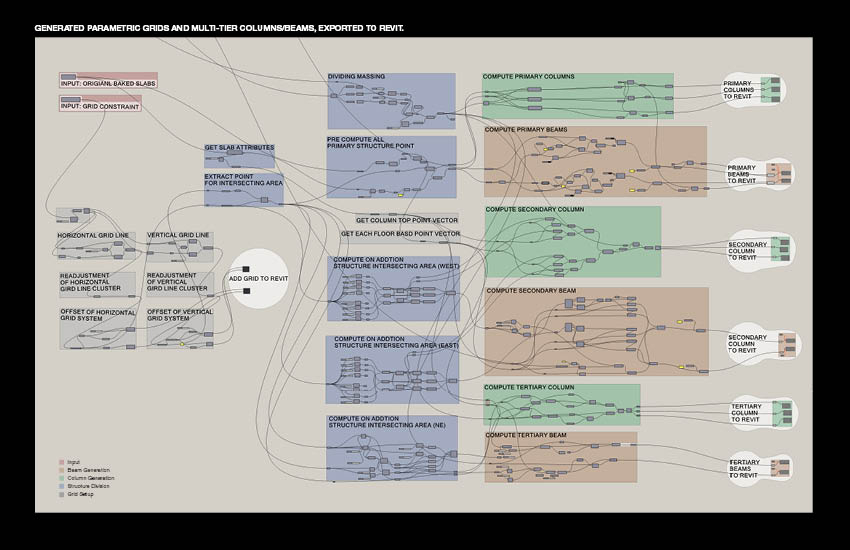
A Grasshopper script generates the entire building structure parametrically and pushes it into Revit through Rhino.Inside.Revit. It establishes grid systems, then computes primary, secondary, and tertiary columns and beams across the full tower height. All structural members are exported as native Revit families, eliminating manual placement entirely.

Adaptive Facade System

The facade is constructed from a five-point adaptive family in Revit, where each panel is defined by four corner points plus a fifth control point that governs the opaque-to-transparent ratio. This parametric setup allows every panel across the tower to carry unique coverage values while remaining a single, manageable family type within the BIM model.

Project Catagory

Institution

Columbia Universtiy GSAPP

Date

Location

New York, NY

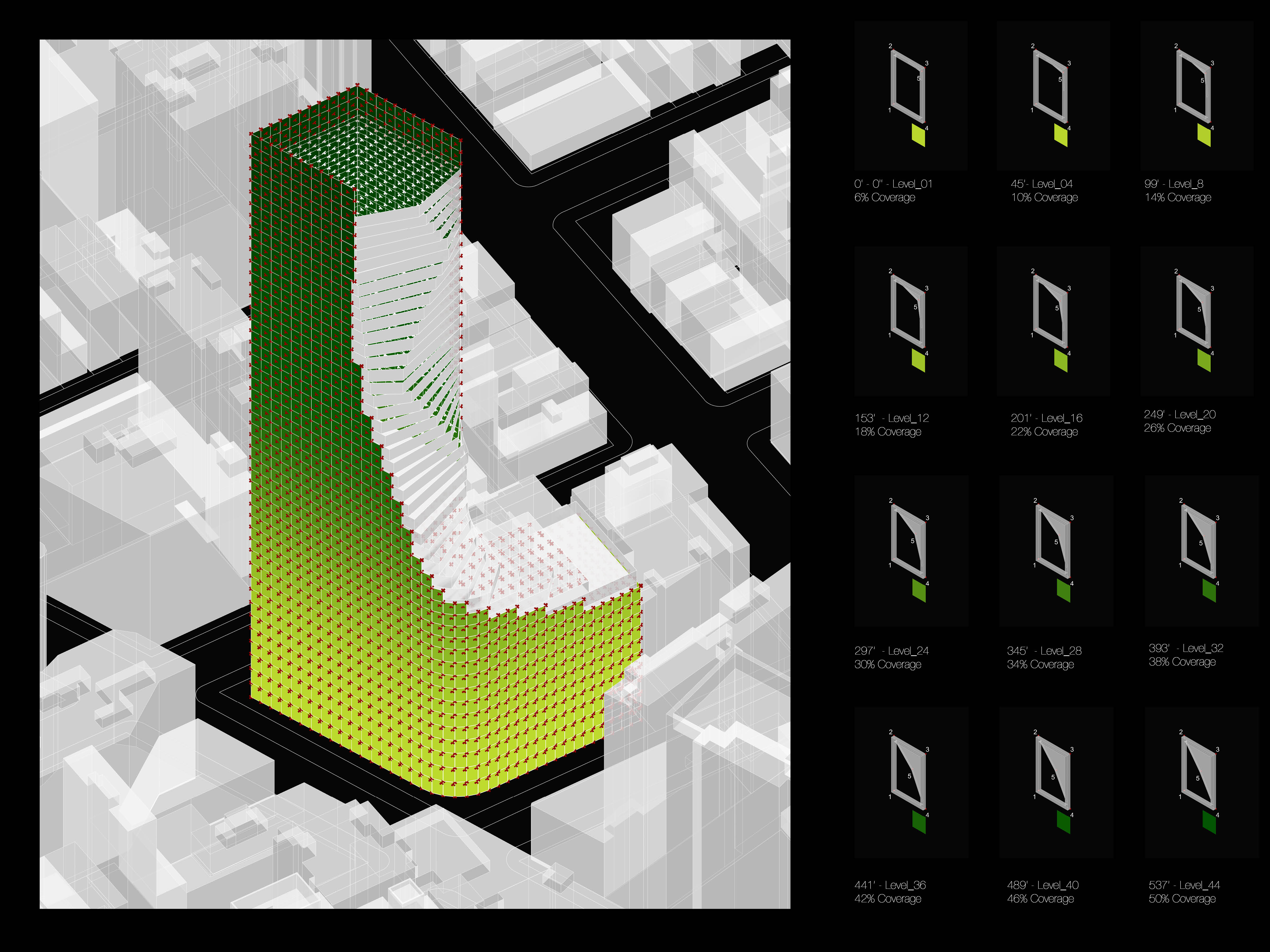
Gradient Coverage Strategy

The facade transitions from maximum transparency at the retail base to controlled enclosure at the residential crown. Coverage climbs from six percent at level one to fifty percent at the uppermost floors. This vertical modulation responds to program: retail demands visibility, offices benefit from balanced daylight, and residences require increasing privacy as height intensifies.

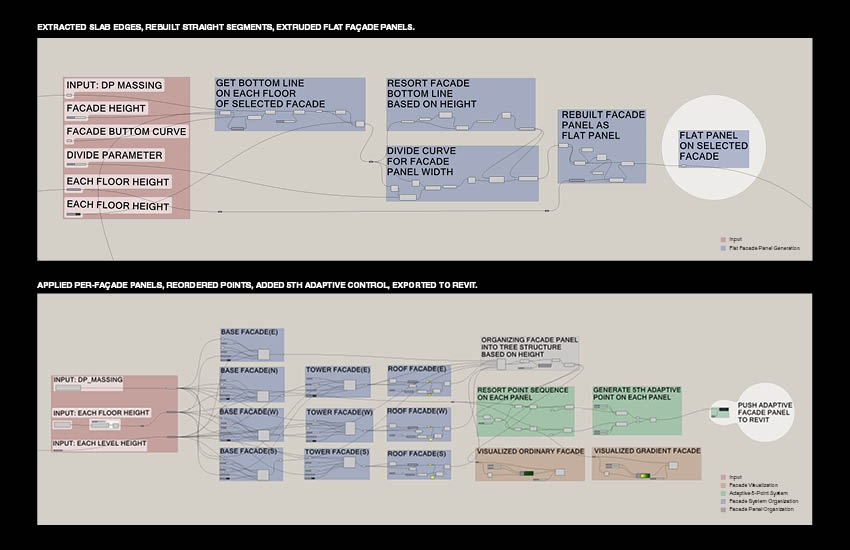
Five-Point Adaptive Family Export to Revit

The script extracts slab edges, rebuilds them as straight segments, and divides each into panel-width units. A second stage applies per-facade logic across base, tower, and roof zones on all orientations, reorders points, and generates the fifth adaptive control point. The entire facade family is then pushed to Revit as native geometry.

Project Catagory

Institution

Columbia Universtiy GSAPP

Date

Location

New York, NY

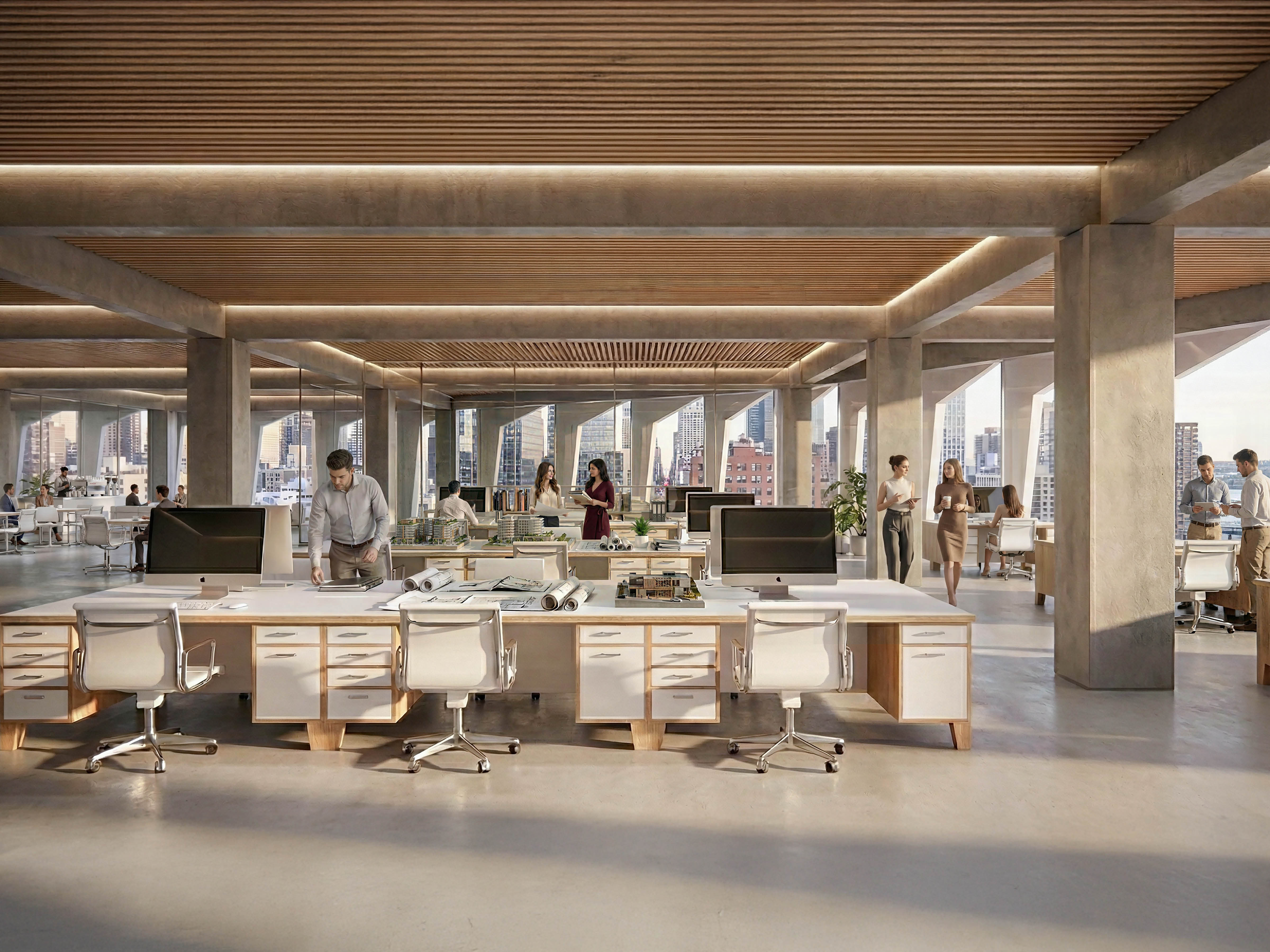
AI-Assisted Visualization and Iterative Rendering

Final imagery was produced through an AI-assisted pipeline using diffusion-based generation. Multiple rounds of iterative refinement transformed 3D exports into photorealistic scenes. Localized inpainting refined facade reflections, interior furnishing, and streetscape context, collapsing the gap between schematic visualization and presentation-quality rendering.

Computation as the Medium of Architectural Delivery

Throne 30 demonstrates that computation need not remain confined to form-finding. When parametric workflows extend from site analysis through zoning, structure, facade, and BIM documentation, every design decision becomes simultaneously a deliverable decision. The project collapses the divide between exploration and production, suggesting a broader shift: architecture practiced not as isolated phases handed between teams, but as an integrated, data-driven process where analysis, intent, and documentation coexist within a single living model. In an era of intensifying urban complexity, this workflow offers a path toward architecture more rigorous, more responsive, and more precisely aligned with the ambitions of the contemporary city.


Next Project